Showing posts with label Stack. Show all posts

Saturday, August 9, 2014

No. 54 - Merge Ranges


Questions: Given an array of ranges, please merge the overlapping ones. For example, four ranges [5, 13], [27, 39], [8, 19], [31, 37] (in blue in  Figure1) are merged into two ranges, which are [5, 19] and [27, 39] (in green in Figure 1).
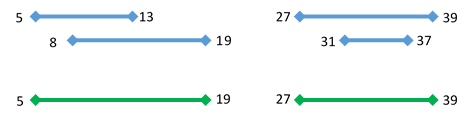
Figure 1: Merge four ranges [5, 13], [27, 39], [8, 19] and [31, 37] (in blue), and get [5, 19], and [27, 39] (in green)
Analysis: Before we analyze how to merge an array of ranges, let’s discuss how to merge two ranges. When two ranges don’t overlap each other, they can’t merge. When two ranges overlap, the less starting value of two ranges becomes the starting value of the merged range, and the greater ending value of two ranges becomes the ending value of the merged range.
Therefore, two ranges [5, 13] and [8, 19] are merged into a new range [5, 19], and two ranges [27, 39] and [31, 37] are merged into a new range [27, 39]. The two merged ranges can’t be merged further because they don’t overlap.
The next question is: How to check whether two ranges overlap each other? When two ranges overlap, there is at least on node in a range is contained in the other range. For instance, the starting value 8 of the range [8, 19] is contained in the range [5, 13], therefore, the two ranges [5, 13] and [8, 19] overlap. No nodes in the range [8, 19] are contained in the range [31, 37], so the two ranges don’t overlap.
The following code shows how to merge two ranges, as well as to check whether two ranges overlap:
public bool Contains(int value)
{
    if (value >= this.Start && value <= this.End)
    {
        return true;
    }
 
    return false;
}
 
public bool Overlaps(Range other)
{
    if (other == null)
    {
        return false;
    }
 
    if (this.Contains(other.Start) || this.Contains(other.End)
        || other.Contains(this.Start) || other.Contains(this.End))
    {
        return true;
    }
 
    return false;
}
 
public Range Merge(Range other)
{
    if (!this.Overlaps(other))
    {
        throw new ApplicationException("Can't merge two ranges.");
    }
 
    int newStart = (this.Start < other.Start) ? this.Start : other.Start;
    int newEnd = (this.End > other.End) ? this.End : other.End;
 
    return new Range(newStart, newEnd);
}
Now let’s move on to merge an array of ranges.  The first step is to sort the ranges based on their start values. When the ranges [5, 13], [27, 39], [8, 19], and [31, 37] are sorted, they are in the order of [5, 13], [8, 19], [27, 39], and [31, 37].
The next steps are to merge the sorted ranges. The merged ranges are inserted into a data container. At each step, a range is retrieved from the sorted array, and merged with the existing ranges in the container.
At first the data container is empty, and the first range [5, 13] is inserted into the container directly, without merging. Now there is only one range [5, 13] in the container.
Then the next range [8, 19] is retrieved. Since it overlaps the range[5, 13], and they become [5, 19] when they merged. There is still only one range, which is [5, 19] in the container.
The next range [27, 39] is retrieved, which does not overlap the range [5, 19] in the container, so it is inserted into the range directly without merging. There are two ranges [5, 19] and [27, 39] in the container.
The last range in the sorted array is [31, 37]. It overlaps the last range [27, 39] in the container. Therefore, the last range [27, 39] is deleted from the container, and then the merged range is inserted into the container. At this step, the merged range is also [27, 39].
Ranges in the container are also sorted based on their starting values, and they don't overlap each other. Notice that it's only necessary to check whether the new range overlap the last range in the container. Why not the other ranges in the container? Let's analyze what would happen when a new range in the sorted array overlap two ranges in the container, with Figure 2:
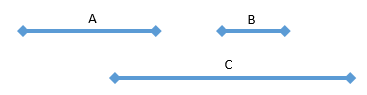
Figure 2: It causes problems when a new range overlaps two ranges in the merged container
 
In Figure 2, the container has two ranges A and B, and a new range C is retrieved from the sorted array, which overlaps the ranges A and B. Since C overlaps A, the starting value of C should be less than the ending value of A. On the other hand, C is retrieved from the sorted array later than B, the starting value of C is greater than starting value of B. Additionally, B is behind A and they don't overlap, so the starting value of B is greater than the ending value A. Therefore, the starting value of C is greater than the ending value of A. It contradicts.

Since it's only necessary to merge new ranges from the sorted array with the last range in the container. We implement the container as a stack, and the last range is on the top of the stack.

The following is the C# code to merge a sort an array of ranges:

public static Range[] Merge(Range[] ranges)
{
    Stack<Range> results = new Stack<Range>();
    if (ranges != null)
    {
        Array.Sort(ranges, CompareRangeByStart);
 
        foreach (var range in ranges)
        {
            if (results.Count == 0)
            {
                results.Push(range);
            }
            else
            {
                var top = results.Peek();
                if (top.Overlaps(range))
                {
                    var union = top.Merge(range);
                    results.Pop();
                    results.Push(union);
                }
                else
                {
                    results.Push(range);
                }
            }
        }
    }
 
    return results.Reverse().ToArray();
}
The code with unit tests are shared at http://ideone.com/kg4TwM.

More coding interview questions are discussed in my book< Coding Interviews: Questions, Analysis & Solutions>. You may find the details of this book on Amazon.com, or Apress.

The author Harry He owns all the rights of this post. If you are going to use part of or the whole of this ariticle in your blog or webpages, please add a reference to http://codercareer.blogspot.com/. If you are going to use it in your books, please contact him via zhedahht@gmail.com . Thanks.


Wednesday, February 20, 2013

No. 41 - Group of 1s in a Matrix

Problem: Given a matrix with 1s and 0s, please find the number of groups of 1s. A group is defined by horizontally or vertically adjacent 1s. For example, there are four groups of 1s in Figure 1 which are drawn with different colors.
Figure 1: A matrix with four groups of 1s. Different groups are drawn with different colors.

Analysis: All numbers in the matrix are scanned one by one. When a 1 is met, a group of 1s has been found, and then all 1s in the group are flipped to 0s.
For example, the first entry in the matrix of Figure 1 contains 1, so the first group of 1s is found when we access to the first entry. After all 1s in the group have been flipped to 0s, the matrix becomes the one in Figure 2.
Figure 2: The new matrix after all 1s in the first group (in the red boundary) have been flipped
 
Therefore, the overall function to count the groups of 1s in a matrix can be implemented in the following C++ code:
int groupOf1(int* nums, int rows, int cols)
{
    if(nums == NULL || rows <= 0 || cols <= 0)
        return 0;

    int group = 0;
    for(int i = 0; i < rows * cols; ++i)
    {
        if(nums[i] == 1)
        {
            group++;
            flipAdjacent1(nums, rows, cols, i);
        }
    }

    return group;
}

Let’s move on to flip 1s inside a group. Actually, it is an application of the seed filling algorithm. When we are going to flip a group starting from an entry, we take the entry as a seed and push it into a stack. At each step, we get an entry from the top of the stack, flip it, and then push its neighboring entries into the stack. The process continues until the stack is empty. The following code implements this algorithm:
void flipAdjacent1(int* nums, int rows, int cols, int index)
{
    stack<int> group;
    group.push(index);
    while(!group.empty())
    {
        int topIndex = group.top();
        group.pop();
        nums[topIndex] = 0;

        int row = topIndex / cols;
        int col = topIndex % cols;

        // up
        if(row > 0 && nums[(row - 1) * cols + col] == 1)
            group.push((row - 1) * cols + col);
        // right
        if(col < cols - 1 && nums[row * cols + col + 1] == 1)
            group.push(row * cols + col + 1);
        // down
        if(row < rows - 1 && nums[(row + 1) * cols + col] == 1)
            group.push((row + 1) * cols + col);
        // left
        if(col > 0 && nums[row * cols + col - 1] == 1)
            group.push(row * cols + col - 1);
    }
}

More coding interview questions are discussed in my book <Coding Interviews: Questions, Analysis & Solutions>. You may find the details of this book on Amazon.com, or Apress.

The author Harry He owns all the rights of this post. If you are going to use part of or the whole of this ariticle in your blog or webpages, please add a reference to
http://codercareer.blogspot.com/. If you are going to use it in your books, please contact him via zhedahht@gmail.com . Thanks.

Wednesday, February 6, 2013

No. 39 - Stacks Sharing an Array

Problem 1: How can you implement two stacks in a single array, where no stack overflows until no space left in the entire array space?

Analysis: An array has two ends, so each of the two stacks may grow from an end in the array. Figure 1 below shows the initial status of the array and two stacks (assuming the capacity of the array is 10).
Figure 1: Initial status of the array and two stacks
Since two stacks are empty at first, so indexes of top items are initialized as -1 and 10 at first.
When items are pushed into first stack, it grows from left to right. Similarly, the second stack grows from right to left when items are items are pushed into it. For example, Figure 2 shows the status when three items a, b and c are pushed into the first stack, and d, e are pushed into the second stack.

Figure 2: The status after three items are pushed into the first stack and two items are pushed into the second stack 

No more items can be pushed into stacks when two top items are adjacent to each other, because all space in the array has been occupied.

Our solution can be implemented with the following C++ class:
template <typename T, int capacity> class TwoStacks
{
public:
    TwoStacks()
    {
        topFirst = -1;
        topSecond = capacity;
    }
    T top(int stackIndex)
    {
        validateIndex(stackIndex);
        if(empty(stackIndex))
            throw new exception("The stack is empty.");
        if(stackIndex == 0)
            return items[topFirst];
        return items[topSecond];
    }
    void push(int stackIndex, T item)
    {
        validateIndex(stackIndex);
        if(full())
            throw new exception("All space has been occupied.");
        if(stackIndex == 0)
            items[++topFirst] = item;
        else
            items[--topSecond] = item;
    }
    void pop(int stackIndex)
    {
        validateIndex(stackIndex);
        if(empty(stackIndex))
            throw new exception("The stack is empty.");
        if(stackIndex == 0)
            --topFirst;
        else
            ++topSecond;
    }
    bool empty(int stackIndex)
    {
        if(stackIndex == 0 && topFirst == -1)
            return true;
        if(stackIndex == 1 && topSecond == capacity)
            return true;
        return false;
    }
private:
    bool full()
    {
        return (topFirst >= topSecond - 1);
    }
    void validateIndex(int stackIndex)
    {
        if(stackIndex < 0 || stackIndex > 1)
            throw new exception("Invalid Stack Index.");
    }
private:
    T items[capacity];
    int topFirst;
    int topSecond;
};

Problem 2: How can you implement n (n > 2) stacks in a single array, where no stack overflows until no space left in the entire array space?

Analysis: An array only has two ends, so we need new strategies to implement more than two stacks in a single array.

We may implement the array like a list, where each item in the array has a link to another item. When an item has not been occupied by any stacks and it is available, it is linked to the next available item. When an item is pushed into a stack, it is linked to the previous item in the stack. That’s to say, there are n + 1 list in total in the system if there are n stacks sharing an array, a list for the available space left in the array, and a list for each stack.

Let’s take three stacks sharing an array with capacity 10 as an example. Figure 3 shows the initial status for the array and stacks. Each item in the array has two blocks, one for item data and the other for the index of another block.
Figure 3: Initial status of three stacks sharing an array


As shown in Figure 3, each item is linked to the next item (the link block of the ith item is i+1). The head of list for available items in the array points to the item at position 0, which is the Ava pointer in the figure. Since three stacks are empty, their top (Top1, Top2 and Top3 in the figure) are initialized as -1.

Let’s try to push an item a into the first stack. Currently the first available item is at the position 0, so we set its data block as a. The link block of the item is 1, which means the next available item is at the position 1, so we update the Ava pointer to the position 1. Additionally, the link block of the item at the position 1 should be updated to -1, the previous top index of the first stack. Lastly, we update to top index of the first stack to 0. The status of the array and stacks are shown in Figure 4.
Figure 4: The status after pushing a into the first stack
Let’s push two more items b and c into the first stack. The operations are similar as before, and the status is shown in Figure 5.
Figure 5: The status after adding two more items, b and c, into the first stack
In the next step we are going to push another d into the second stack. Most operations are similar as before. The link block in the item at the position 3 is updated to -1, since the second stack is empty before and its top index is -1 previously. And then the top index of the second stack is updated to 3. The status after adding d into the second stack is shown in Figure 6.

Figure 6: The status after pushing d into the second stack
If we continue to push three more item e, f, and g into the second stack, the status is shown in Figure 7.
Figure 7: The status after pushing three more items, e, f, and g, into the second stack
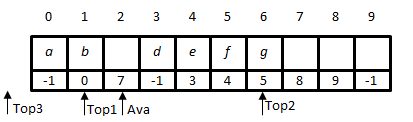
At this time we are going to pop an item from the first stack. Since the top index of the first stack is 2, the item to be popped off is at the position 2. The link value in that item is 1, which means the previous top in the first stack is at the position 1 in the array, so we update the top index of the first stack as 1. Now the item at the position 2 becomes available, it should be linked to the list for available items. We move the Ava pointer to 2, and then update the link value of the item at the position 2 as 7, which is the previous head position of the list for available items. The status is shown in Figure 8.
Figure 8: The status after popping an item from the first stack
If we pop an item off the second stack, the item at the position 6 will be linked to the list for available items too. Figure 9 depicts the status after the related operations.
Figure 9: The status after popping an item off the second stack
If we push h into the third stack, it will be placed into the item at the position 6 because Ava points to that item. The next available item is at the position 2 (the link value in the item at the position 6). Therefore, the head of the list for available items points to location 2, as shown in Figure 10.
Figure 10: The status after pushing h into the third stack
Let’s continue to push four more items into the third stack, i, j, k, and l. The status after these four items are pushed is shown in Figure 11. At this time, there are two items in the first stack (a and b), three items in the second stack (d, e and f), and five items in the third stack (h, i, j, k, and l). Please note that items inside a stack are not necessarily adjacent. 
Figure 11: The status after pushing i, j, k, l into the third stack
After l is pushed into the item at the position 9, the Ava pointer is update to -1 (the previous link value in the item at the position 9), which means all items in the array have been occupied by stacks. We can’t push more items until some items are popped off.
The source code in C++ to implement stacks sharing an array is listed below:
template <typename T, int capacity, int count> class Stacks
{
public:
    Stacks()
    {
        int i;
        for(i = 0; i < capacity - 1; ++i)
            items[i].link = i + 1;
        items[i].link = -1;
        emptyHead = 0;

        for(i = 0; i < count; ++i)
            stackHead[i] = -1;
    }

    T top(int stackIndex)
    {
        validateIndex(stackIndex);
        if(empty(stackIndex))
            throw new exception("The stack is empty.");

        return items[stackHead[stackIndex]].data;
    }

    void push(int stackIndex, const T& item)
    {
        validateIndex(stackIndex);
        if(full())
            throw new exception("All space has been occupied.");

        Item<T>& block = items[emptyHead];
        int nextEmpty = block.link;

        block.data = item;
        block.link = stackHead[stackIndex];
        stackHead[stackIndex] = emptyHead;

        emptyHead = nextEmpty;
    }

    void pop(int stackIndex)
    {
        validateIndex(stackIndex);
        if(empty(stackIndex))
            throw new exception("The stack is empty.");

        Item<T>& block = items[stackHead[stackIndex]];
        int nextItem = block.link;

        block.link = emptyHead;
        emptyHead = stackHead[stackIndex];
        stackHead[stackIndex] = nextItem;
    }

    bool empty(int stackIndex)
    {
        return (stackHead[stackIndex] < 0);
    }

private:
    void validateIndex(int stackIndex)
    {
        if(stackIndex < 0 || stackIndex >= count)
            throw new exception("Invalid index of stack.");
    }

    bool full()
    {
        return (emptyHead < 0);
    }

private:
    template <typename T> struct Item
    {
        T data;
        int link;
    };

private:
    Item<T> items[capacity];
    int emptyHead;
    int stackHead[count];
};

More coding interview questions are discussed in my book <Coding Interviews: Questions, Analysis & Solutions>. You may find the details of this book on Amazon.com, or Apress.

The author Harry He owns all the rights of this post. If you are going to use part of or the whole of this ariticle in your blog or webpages, please add a reference to 
http://codercareer.blogspot.com/. If you are going to use it in your books, please contact him via zhedahht@gmail.com . Thanks.